How to price loyalty points for partners — and why most programs overprice them
Selling points or miles to a partner looks like pure-margin revenue. The price is set by two things — that partner's breakage and the gap between perceived value and settlement cost — and the common mistake isn't charging too little. It's charging too much.
Selling points or miles to a partner — a co-brand card, a retail chain, another travel brand — feels like the highest-margin revenue a program has. Someone hands you cash for a currency you print. But the price isn’t set by retail value or a competitor’s chart, and getting it wrong usually means you’ve priced too high, not too low.
The short answer
The right price for a block of points rests on two numbers: how much of that specific partner’s issuance will go unredeemed — their breakage, not the program’s — and the gap between what a member believes a point is worth and what it actually costs you to settle the redemption. Those two define both your floor and your room. Price above the room and the partner doesn’t walk away; they simply buy less. That is the failure mode I’ve seen most often.
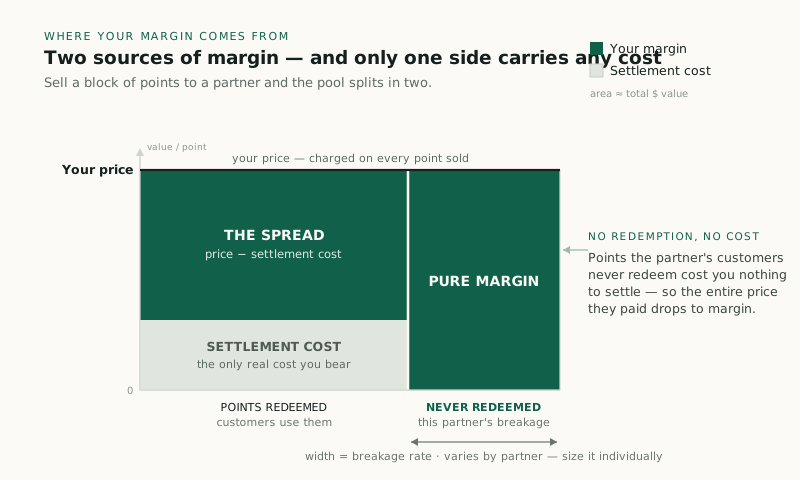
Start with breakage — but the partner’s, not the program’s
Breakage — the share of issued points never redeemed — is where a loyalty currency makes its money, because an unredeemed point is revenue with no matching cost. Most programs know this. Where they go wrong is pricing off a single, blended, program-wide breakage rate.
Breakage isn’t uniform. It varies by partner, by cohort, by how that partner’s customers actually behave. A co-brand card whose holders accumulate and forget breaks very differently from a retail partner whose customers burn points the moment they earn them. Price a high-breakage partner off the program average and you leave margin on the table. Price a low-breakage partner off that same average and you can sell at a loss without noticing. The unit of analysis has to be that partner’s cohort, not the headline number for the whole program.
The second number: perceived value versus settlement cost
The other half of the margin lives in a gap. A member values a point at what it gets them — a flight, a hotel night — which is usually well above its cash cost. You, meanwhile, settle that redemption with the redemption partner at a real cost that is often a fraction of that perceived value.
In an airline or hotel program, that redemption partner is usually the airline or hotel itself — frequently the owner of the program — and the settlement is effectively an internal transfer priced at the marginal cost of an empty seat or an unsold room. Some redemptions flow to third-party partners instead, where you pay closer to a negotiated rate. Your true settlement cost is the blend across all of it. The wider the gap between perceived value and that blended cost, the more room you have to price the points attractively to a partner and still keep margin.
Putting the two together
Partner-specific breakage and the perceived-value-to-settlement spread are what actually set the price. Together they give you a floor — below which you’re quietly subsidizing the partner’s customer acquisition — and a ceiling, above which the partner won’t keep buying. Retail value and market comps tell you nothing useful here; they’re someone else’s economics, not yours.
The mistake is almost always overpricing
When a partner deal underperforms, the instinct is to assume the points were sold too cheaply. In my experience it’s the reverse. Price the currency too high and the partner doesn’t cancel — they just buy less. They issue points more stingily, members earn slower, the program feels less rewarding, and the whole flywheel slows down.
A point only creates value when it’s in circulation: earned, anticipated, redeemed, and — often — broken. Everything compounds on volume. Price the currency so the partner wants to issue more, not less. A slightly thinner margin on a much larger, repeating volume, with breakage working in your favour across all of it, beats a fat margin on a block the partner buys once and never reorders.
The bottom line
Don’t price loyalty points off retail value or a rival’s redemption chart. Price off the two things that determine the economics: that partner’s breakage, and your perceived-value-to-settlement spread. And when you’re unsure, lean cheaper — the goal is a partner who keeps buying and keeps issuing, not a big number on a single invoice.
Common questions
- How should I price loyalty points sold to a partner?
- Off two numbers: that specific partner's breakage, and the gap between what a member perceives a point is worth and what it actually costs you to settle the redemption. Not off retail value or a competitor's chart.
- Why does partner-specific breakage matter more than program breakage?
- Breakage isn't uniform — it varies by partner and by how that partner's customers behave. A blended program-wide rate overcharges low-breakage partners and undercharges high-breakage ones. The unit of analysis is the partner's cohort, not the program average.
- Is it better to price loyalty points high or low?
- Usually lower than instinct says. Overpricing rarely loses the deal outright — it suppresses how many points the partner buys and issues, which slows earning, weakens the program, and stalls the flywheel.